
A good french press coffee ratio starts with 1 part coffee to 15 parts water by weight. That gives most people a rich, balanced cup without making the brew muddy or thin. If your coffee tastes off, adjust the ratio only after checking grind size, steep time, and whether the coffee sat in the press too long.
What is the best French press coffee ratio?
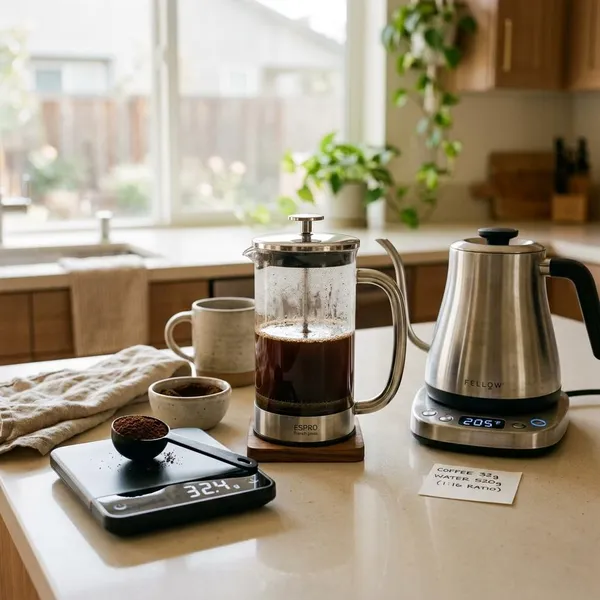
The best starting ratio for French press is 1:15, meaning 1 gram of coffee for every 15 grams of water. Since 1 ml of water is close to 1 gram, you can treat 500 ml of water as about 500 grams for everyday brewing.
Start with a 1 to 15 coffee to water ratio
Use 1:15 as your first recipe because it gives you a stable baseline. For example, 40 g coffee with 600 g water makes about two generous mugs, while 33 g coffee with 500 g water suits one large mug or two smaller cups.
If the cup tastes bitter at 1:15, do not immediately use less coffee. The more likely problems are a grind that is too fine, water that is too hot, steeping too long, or leaving the brew on the grounds after pressing.
Use 1 to 12 or 1 to 14 for stronger coffee
A 1:14 ratio is a good stronger setting without becoming extreme. With 600 g water, that means about 43 g coffee. A 1:12 ratio uses about 50 g coffee for the same water amount and can taste heavy if you drink it black.
This stronger range makes sense when you add milk, brew a dark roast that you want to taste bold, or serve coffee with a filling breakfast. It is less forgiving, so keep the grind coarse to medium-coarse and start with a four-minute steep before changing anything else.
Use 1 to 16 or 1 to 17 for lighter coffee
Try 1:16 if French press coffee often feels too thick or intense. With 600 g water, use about 38 g coffee. Move to 1:17, about 35 g coffee for 600 g water, only if you clearly want a softer cup.
For a slow morning mug you drink black, 1:16 can be more pleasant than forcing a strong brew. Just avoid pairing a very light ratio with an overly coarse grind, because that combination can taste weak, sour, or hollow.
French press coffee ratio chart
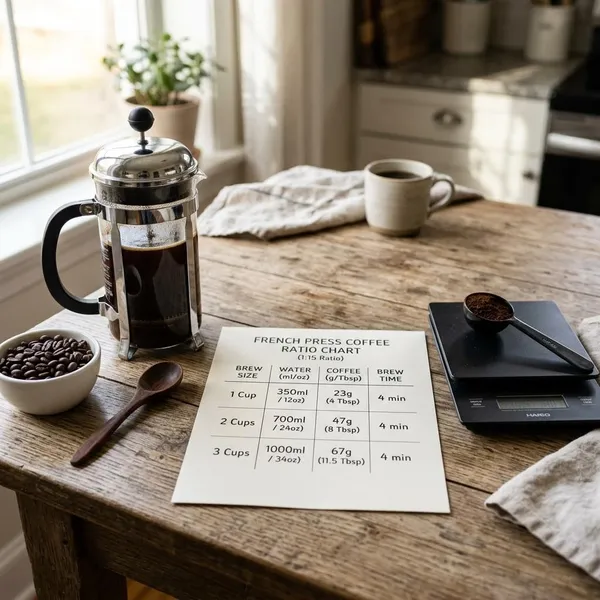
Use this chart as the practical 1:15 baseline. If your French press is marked in "cups," measure the water instead of trusting the label, because French press cup markings are often much smaller than normal mugs.
| Water | Coffee at 1:15 | Best for |
|---|---|---|
| 250 ml | About 17 g | One modest mug |
| 350 ml | About 23 g | One large mug |
| 500 ml | About 33 g | One large travel mug or two small cups |
| 750 ml | About 50 g | Two to three mugs |
| 1 liter | About 67 g | Several servings |
250 ml water with about 17 g coffee
For 250 ml water, use about 17 g coffee. Small batches show measuring mistakes quickly, so this is the size where a scale helps most. If you use tablespoons, expect some variation from one coffee to another.
350 ml water with about 23 g coffee
For 350 ml water, use about 23 g coffee. This is a useful single-person brew size when you want a proper mug without making extra coffee that sits in the press.
If you want it slightly stronger, raise the dose to 24 or 25 g instead of steeping much longer. Increasing time is more likely to add bitterness than clean strength.
500 ml water with about 33 g coffee
For 500 ml water, use about 33 g coffee. This is one of the easiest French press sizes to repeat because it holds heat better than a tiny batch and still pours out quickly after pressing.
750 ml water with about 50 g coffee
For 750 ml water, use about 50 g coffee. This is a good size for two people at breakfast, especially if both cups will be poured soon after brewing.
- Serving right away: brew normally and pour into mugs.
- Drinking slowly: transfer the coffee to a carafe so it does not keep extracting on the grounds.
1 liter water with about 67 g coffee
For 1 liter water, use about 67 g coffee. Large batches are convenient, but they turn bitter faster if they sit in the press. Press slowly, then pour everything into mugs or a separate container.
How to brew French press coffee with a 1 to 15 ratio
Once the ratio is set, the next priority is consistency. Use the same grind, water temperature, and steep time for a few brews before deciding whether the ratio needs changing.
Measure your coffee and water
Measure by weight if you can. A simple recipe is 40 g coffee to 600 g water. Without a scale, use about 2 level tablespoons per 6 ounces of water, but treat that as an estimate rather than a fixed rule.
The first thing to check when your brew changes from day to day is measurement. Scoops can vary by roast level, grind size, and how tightly the coffee settles, which is why a scoop-based recipe can taste different even when you think you used the same amount.
Grind the coffee coarse to medium coarse
A coarse to medium-coarse grind should look a little like coarse salt or dry breadcrumbs. If the plunger is hard to push, the cup tastes muddy, or there is a lot of sludge, the grind is probably too fine.
Add hot water evenly
Pour enough water to wet all the grounds, give the coffee a gentle stir if dry pockets remain, then add the rest of the water. If your kettle has just boiled, waiting 30 to 60 seconds before pouring is a practical way to avoid harshness, especially with darker roasts.
Steep for about four minutes
Start with a 4-minute steep. If the cup is weak, first check whether the grind is too coarse or the ratio is too light. If it is bitter, check for a fine grind, an overlong steep, or coffee left sitting in the press.
A longer steep can work for some lighter roasts, but treat it as a small adjustment. Jumping straight to a much longer brew time often makes French press coffee taste rough rather than stronger.
Press slowly and pour immediately
Press with steady pressure instead of forcing the plunger down. A rushed press stirs up fines and makes the last part of the cup heavier.
Pour the coffee out as soon as you press. This matters most when brewing 750 ml or 1 liter, because a large hot batch left on the grounds can become bitter before everyone finishes their first cup.
Conclusion
Start with 1:15, then adjust only one thing at a time: use 1:14 or 1:12 when you want more body, and 1:16 or 1:17 when you want a gentler cup. The best result usually comes from a steady recipe, a coarse enough grind, a four-minute steep, and getting the coffee out of the press before it turns harsh.