
The best lock types for home security usually start with a quality deadbolt, then change depending on the door: smart deadbolts for daily entrances, mortise locks for heavy doors, multi-point locks for compatible patio doors, and high-security cylinders when key control matters. Before buying anything, check the door style, frame strength, and how your household actually uses that entrance.
What are the best lock types for a home?
For most homes, the strongest practical setup is not one "ultimate" lock on every door. It is the right lock type for each entrance, installed on a solid door with a reinforced strike area. A front door used every day has different needs than a side door, a sliding patio door, or a garden gate.
Deadbolts for most exterior doors
A good deadbolt is still the best default choice for most front, back, and side exterior doors. It uses a solid bolt that extends into the frame, which makes it more resistant to forced entry than a basic spring latch.
- Best fit: standard hinged exterior doors.
- Look for: a full bolt throw, solid construction, and a reinforced strike plate.
- Prefer: ANSI/BHMA Grade 1 or Grade 2 where available.
Smart locks for keyless access
Smart locks are best when convenience is a real daily problem: children coming home from school, guests needing temporary access, or a household that often forgets spare keys. A smart deadbolt is usually a better choice than a smart latch because it keeps the physical strength of a deadbolt while adding codes, app control, or auto-locking.
The weak point is often not "hacking" but fit and reliability. If the door rubs, sags, or needs a push to close, fix that first; a smart lock motor can jam or drain batteries quickly when the bolt does not move cleanly.
Mortise locks for heavy-duty doors
Mortise locks are built into a pocket inside the door, so they are common on older homes, premium entry doors, and heavier wood or metal doors. They can feel more solid in daily use and often combine the latch and lock into one strong internal body.
They are not a casual upgrade for every door. If your door is already prepared for mortise hardware, keeping or upgrading it can be worthwhile. If it is not, cutting the door for a mortise lock is usually a job for a professional.
Multi-point locks for compatible doors
Multi-point locks secure the door at several points along the frame, often near the top, middle, and bottom. That makes them useful for tall patio doors, French doors, and some modern composite or uPVC doors that are designed for this hardware.
They are a strong option when the door is compatible, especially where a large glazed door might flex around a single locking point. They are not usually a simple retrofit for a standard hinged door, so confirm the door system before treating this as an upgrade path.
High-security cylinders for stronger key control
A high-security cylinder is worth considering when the lock body is already good but the keyway is the concern. These cylinders are designed to resist picking, bumping, drilling, and unauthorized key duplication better than basic cylinders.
How to choose the right home lock
Start with the door, not the lock display. A solid hinged front door can often take a deadbolt or smart deadbolt, while a sliding door needs track-based reinforcement and a patio door may need a multi-point system. After compatibility, check tested strength, frame condition, daily access needs, and emergency backup.
Match the lock to the door
The first check is simple: does the lock match the way the door is built and moves? A standard deadbolt works well on many hinged exterior doors, but it is the wrong answer for most sliding doors and may not suit narrow glass-framed doors.
Check the security rating
When you can, use ANSI/BHMA grading as a filter. Grade 1 is the highest common tested level, while Grade 2 is often a strong residential choice. A rated lock gives you a better clue about durability and forced-entry resistance than weight, finish, or packaging claims.
Consider the door and frame strength
A strong lock on a weak frame is a common mistake. Check for cracked jambs, short strike screws, loose hinges, rot, or a bolt that barely enters the strike. If the frame gives way first, a premium lock will not help much.
- Check first: whether the bolt extends fully without pushing the door.
- Upgrade early: the strike plate and screws on main exterior doors.
- Fix before replacing: sagging, rubbing, or misalignment.
Choose the access features you need
Access features should solve a real problem. A keypad makes sense for a busy family, dog walker, cleaner, or short-term guest access. If only one or two adults use the door and everyone carries keys, a simpler mechanical deadbolt may be more reliable and cheaper to maintain.
Plan for backup and emergency access
Every lock needs a failure plan. For smart locks, check whether there is a physical key, emergency battery contact, or another dependable override. For mechanical locks, make sure people inside can exit quickly without searching for a key.
Be especially cautious with double-cylinder deadbolts. They can reduce one risk near glass, but they can create another risk if a key is not immediately available during an emergency.
Best lock types for different entry points
Think of each entrance as its own small decision. The main front door needs strength and daily convenience, a rear door may need the same protection with less visibility, and a sliding patio door needs reinforcement against lifting or forced movement.
Deadbolts for front and back doors
Front and back hinged doors should usually get your first lock budget. A single-cylinder deadbolt with a reinforced strike plate is a practical baseline for most homes, especially when the door is solid and the frame is in good condition.
Do not leave the back door as an afterthought. Rear entrances are often less visible from the street, so they deserve the same basic level of protection as the front door.
Smart deadbolts for main daily entrances
A smart deadbolt is strongest as a daily-use upgrade, not just a gadget. It works well on the door your household uses most because codes, auto-locking, and temporary access actually save effort there.
Multi-point locks for compatible patio doors
For compatible hinged patio or French doors, a multi-point lock can be a better fit than relying on one central deadbolt. It holds the door at several points, which can reduce flex and improve how the door seals and feels.
If the door was not built for multi-point hardware, forcing the upgrade may cost more than it is worth. In that case, improving the existing lock, hinges, frame, or door unit may be the more sensible route.
Specialty locks for sliding doors
Sliding doors need hardware made for sliding movement. The usual practical setup is the main latch plus secondary reinforcement, such as a track bar, anti-lift device, or an added lock designed for that frame type.
Padlocks for gates, sheds, and garages
Padlocks make sense for gates, sheds, detached garages, and utility areas, but only when the surrounding hardware is also strong. A hardened shackle on a flimsy hasp is not much of an upgrade.
- For year-round outdoor use: choose corrosion-resistant materials.
- For exposed gates: consider a shrouded shackle to reduce cutting access.
- For sheds: reinforce the latch or hasp, not only the lock.
What makes a home lock secure
A secure lock works as part of a system: lock body, cylinder, strike plate, door, frame, hinges, and installation. If one part is weak, that is where the entry point is most likely to fail.
Strong lock construction
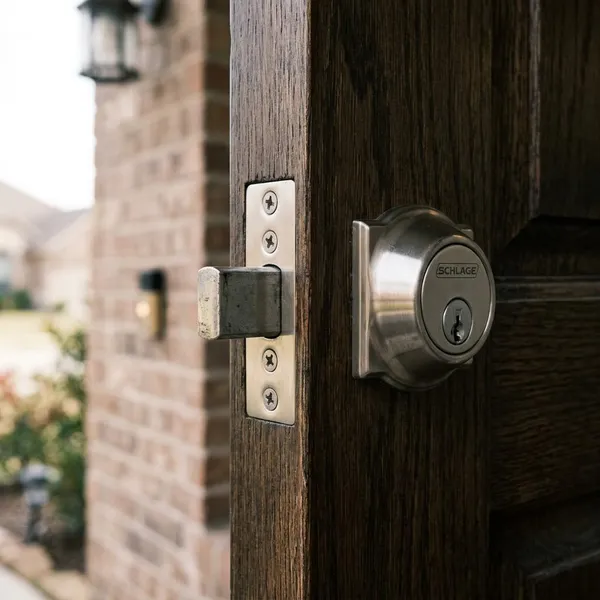
Strong construction means the bolt, housing, and internal parts can handle both daily wear and attempted force. A smooth key turn, firm thumb-turn, and clean bolt movement are good signs, but tested quality matters more than a heavy-looking finish.
A reinforced strike plate
The strike plate is where many doors fail during forced entry. A reinforced plate with longer screws can anchor the deadbolt area into stronger framing rather than only the thin jamb material.
This is often one of the best low-cost upgrades for older homes or builder-grade exterior doors. If the current strike is small, loose, or held by short screws, fix that before spending heavily on decorative hardware.
Pick and drill resistance
Pick and drill resistance protects the cylinder from quieter attacks. Features such as hardened inserts, security pins, or restricted keyways can make tampering slower and less predictable.
A strong door and frame
The door slab and frame carry the lock's strength. Solid-core wood, steel, and quality composite doors usually support exterior locks better than hollow or damaged doors.
If the door is warped, the hinges are loose, or the frame is split, repair those issues first. A better lock cannot compensate for a bolt that does not land fully in the strike.
Proper installation
Installation decides whether the lock's security features actually work. The bolt should extend fully, the hardware should sit tight, and the door should lock without lifting, pushing, or pulling it into place.
Many standard deadbolts are manageable DIY projects on a pre-drilled, well-aligned door. Mortise locks, high-security cylinders, unusual door thicknesses, and badly misaligned doors are better handled by a locksmith or experienced installer.
Conclusion
Choose the lock after you understand the door, not before. For most homes, that means a well-rated single-cylinder deadbolt on standard exterior doors, a smart deadbolt where keyless access genuinely helps, and specialty hardware for patio, sliding, or heavy-duty doors. The most secure choice is usually the one that fits cleanly, locks every time, and is supported by a solid frame and strike plate.