
If you are checking whether the assembly required television show is a good family watch, the short answer is: yes for many older kids, especially with an adult nearby. It is a light DIY competition with familiar hosts, real workshop builds, mild language, and enough power-tool footage that younger viewers may need context.
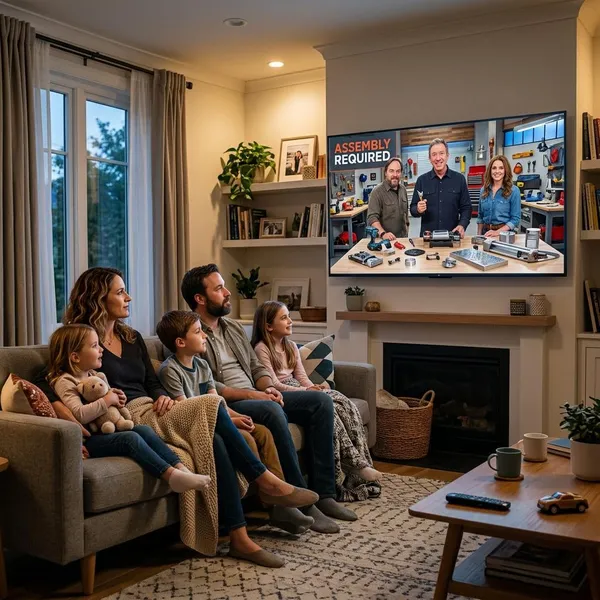
What is the Assembly Required television show?
Assembly Required is a History Channel competition series built around home inventors and DIY builders. Contestants work from their own shops, tackle odd practical challenges, and send their finished creations in for testing.
A DIY competition series from History
The format is simple: makers receive a challenge, build a working device, and compete on creativity, usefulness, and performance. The projects are often strange enough to feel playful, but they still involve real measuring, cutting, fastening, testing, and redesigning.
That makes the show easy to follow for families. A child does not need engineering knowledge to understand whether a machine works, but an adult can still point out useful lessons about planning, trial and error, and why a sturdy build matters.
A reunion for Tim Allen and Richard Karn
Part of the appeal is seeing Tim Allen and Richard Karn together again. The show is not a Home Improvement sequel, but it clearly leans on the same tool-centered comic energy that many adults remember.
A remote contest filmed in home workshops
The remote setup gives the series a different feel from studio competitions. Contestants build in garages, sheds, and personal workshops, so the spaces look more like real hobby areas than polished TV sets.
This is one of the better parts for curious kids: it shows that making things can happen in ordinary spaces. The trade-off is that the contestants are not side by side, so the show has less live competition tension and more edited check-ins.
A mix of building, repair, and light comedy
The show works best when you want relaxed entertainment with a practical edge. There are tools, inventions, repairs, jokes, and final tests, but not a deep step-by-step lesson.
Who hosts Assembly Required?
The hosting team is the reason many people try the show in the first place. Tim Allen and Richard Karn bring the familiar comedy rhythm, while April Wilkerson adds more grounded maker knowledge.
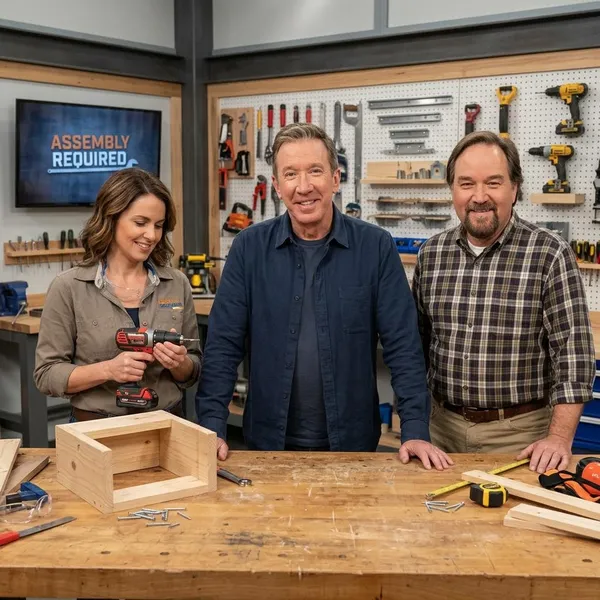
Tim Allen leads the competition
Tim Allen is the lead host, introducing challenges and reacting to the builds with his usual energetic, tool-joke-heavy style. He gives the show a recognizable personality, especially for viewers who already connect him with home workshop comedy.
Parents should mainly watch the tone. His jokes are usually mild, but they often rely on sarcasm, exaggeration, or small put-downs. That may be fine for tweens who understand the humor, but younger kids may need a reminder that TV teasing is not always a good model for real life.
Richard Karn co-hosts and adds commentary
Richard Karn plays more of a steady co-host role. He reacts to the inventions, joins the judging moments, and often helps keep the banter from feeling too sharp.
He also gives casual viewers an easy way into the show. Instead of turning every build into technical analysis, his comments often focus on whether a device seems useful, funny, or likely to survive the test.
April Wilkerson gives technical advice
April Wilkerson is the show's strongest practical voice. When she comments on materials, mechanisms, or design problems, the series becomes more useful for viewers who actually care how things work.
Her role matters for families with kids who are genuinely interested in making. A child who already watches DIY videos or likes taking things apart may get more value from her explanations than from the host banter.
Is Assembly Required suitable for children?
For most families, Assembly Required is better for older kids and tweens than for preschoolers or very young elementary-age viewers. The content is not extreme, but the mix of mild language, teasing, and serious tools makes co-viewing the safer choice.
The show carries a TV-PG language rating
The TV-PG language rating is a fair signal: this is not a harsh adult reality show, but it is not made for very young children either. The concern is mostly language and humor, not violence or frightening content.
- Usually fine: older kids used to mild network comedy.
- Worth previewing: families with stricter language rules.
- Less ideal: children who repeat sarcastic lines immediately.
Mild language appears in some episodes
Some episodes include mild words and softened swearing. It is not constant, but it appears enough that parents who avoid words like "hell" or "crap" may notice.
Teasing and insults stay fairly light
The teasing is generally playful rather than mean, but it is part of the show's rhythm. Tim Allen's style in particular can include jabs at people, projects, or situations.
This is not a reason every family needs to skip the show. It simply means parents may want to say, "That line was meant as a joke, but we would not talk to someone that way in our own workshop." That quick correction can be more useful than treating the show as either perfectly harmless or completely off-limits.
Power tools add a need for adult guidance
The biggest safety issue is not the rating; it is the tool use. Contestants work with equipment such as saws, drills, grinders, and other workshop tools, and the show does not always slow down to explain training, protective gear, or safe setup.
- Check first: whether your child understands that these tools are adult-only or supervised-use items.
- Good follow-up: offer a safe build using cardboard, tape, craft sticks, or basic hand tools.
- Common mistake: letting the excitement of the test scene turn into "I want to try that" without a safety talk.
Co-viewing suits younger maker fans
Co-viewing is the best fit for younger children who love machines, repairs, or invention videos. An adult can explain why a design fails, what tool is being used, and why the contestant needs more than enthusiasm to finish safely.
For a casual family movie-night style watch, the show may simply be light entertainment. For a child who is already sketching inventions or asking to use tools, it works better as a conversation starter than as background TV.
Who will enjoy Assembly Required most?
The show is easiest to recommend to viewers who like DIY culture but do not need a serious engineering lesson. It has enough real making to feel practical, but the relaxed competition and host chemistry are just as important as the builds.
Families interested in DIY projects
Families who already enjoy weekend repairs, garage projects, or "how would you fix this?" conversations will probably get the most natural value from the show. The builds can lead to simple discussions about planning, testing, and why the first version of an idea often needs changes.
Children curious about building and repair
Kids who like inventions, tools, and problem-solving may find the show motivating, especially if they are old enough to understand that TV builds are edited and supervised. A good next step is not handing over a power tool; it is asking them to sketch their own safer version of the idea.
Adults who remember Home Improvement
Adults with warm memories of Home Improvement are a clear audience. The Allen-and-Karn reunion gives the series a familiar comfort, even when a particular challenge is not especially memorable.
Viewers who like relaxed competitions
This is a low-pressure competition show. It does not lean heavily on harsh drama, big emotional conflict, or intense elimination tension, which makes it easier to watch casually.
That calmer pace is helpful for families who want something light after dinner. Viewers who prefer fast, high-stakes reality competitions may find it a little too gentle.
Fans of practical maker shows
Maker-show fans can enjoy Assembly Required if they accept its limits. It shows clever ideas and real fabrication, but it is not the best choice for detailed instruction or repeatable project plans.
If your priority is educational depth, a more STEM-focused show may be a better match. If your priority is seeing creative people solve odd problems with tools and improvisation, this one is worth sampling.
Conclusion
Assembly Required is a solid pick for families who want a mild, tool-themed competition with familiar hosts and a bit of real maker thinking. I would treat it as a co-viewing choice for younger kids, an easy watch for tweens who understand the humor, and a nostalgia-friendly option for adults who miss the Tim Allen and Richard Karn dynamic.